The Real Story of Azazel

Azazel
.jpg)

Azazel was either a mysterious desert demon to whom the ancient Israelites sacrificed a scapegoat on the day of Yom Kippur, or else a rugged cliff upon which the scapegoat was cast down to atone for Israel's sins.
The only mention of "Azazel" in the Torah is found in the Book of Leviticus, which describes God ordering the high priest Aaron to "place lots upon the two goats, one marked for the Lord and the other marked for Azazel" (16:18). Aaron was to confess over the second goat all the iniquities and transgressions of the Israelites and then set the goat free in the wilderness (Lev. 16:21-22), likely throwing it over a cliff.
Most rabbis (fearing contamination from polytheism) interpreted "Azazel" as the rugged mountain cliff from which the scapegoat was cast down on Yom Kippur, but some (such as Nachmanides) argued that Azazel belongs to the class of "se'irim," goat-like demons haunting the desert, to which the Israelites were wont to offer sacrifice. Both views have been variously endorsed and debated in Jewish tradition. Viewed as a demon of the desert, Azazel seems to have been closely interwoven with the Book of Enoch as the seducer of men and women, and leader of the rebellious hosts (Yoma 67b).

The word Azazel (‘ăzaz’ēl) derives from the Hebrew roots ‘ăzaz ("to be strong") and ’ēl ("God"). "God has been strong," "God strengthens," or "strong one of God." According to some scholars, however, this compound could also figuratively mean "impudence" (i.e., strengthened against someone) or "impudent to God." Alternatively, the name may refer to the rugged and strong mountain cliff from which the goat was cast down.
Azazel was translated as "scapegoat" in the King James Version of the Bible (1611), which relied upon William Tyndale's translation of the Bible about 1530 that split azazel into the component parts ez ozel: literally, the "goat that departs," hence "the goat that escapes." Since this goat, with the sins of the people placed on it, was then sent over a cliff or driven into the wilderness to perish, the word "scapegoat" came to mean a person, often innocent, who is blamed or punished for the sins, crimes or sufferings of others.
According to Talmudic interpretation, the term "Azazel" designated a rugged mountain or precipice in the wilderness from which the goat was thrown down, using for it as an alternative the word "Ẓoḳ" (Yoma vi. 4). "Azazel" is regarded as a compound of "az," strong or rough, and "el," mighty, therefore a strong mountain. This derivation is presented by a Baraita, cited Yoma 67b, that Azazel was the strongest of mountains.
The Talmud (Yoma 67b) identifies Azazel as the name of a cliff over which a goat was driven in the atonement ritual for Yom Kippur. This version was cited by the biblical commentator Rashi, who took "azazel" to mean "rough ground" or "cliff," and this meaning was accepted by many Jewish commentators who wished to avoid contamination of the Torah by traces of polytheism or the belief in demons. Ibn Ezra took "Azazel" to refer to "a mountain near Sinai," while G. R. Disker took the "rough ground" to be Dudael, a rocky place where the fallen angel Azazel is imprisoned" (I Enoch 10:4-6). It has also been identified with Hudedun, "a rocky terrace in the wilderness, ten miles from Jerusalem."

In the Hebrew Bible and Rabbinical literature
The first appearance of the name "Azazel" is in the Book of Leviticus 16:8, when God orders the high priest Aaron to "place lots upon the 2 goats, one marked for the Lord and the other marked for Azazel" on the Jewish Day of Atonement. The goat designated by lot for the Lord is to be used as a sin offering, while the goat designated for Azazel "shall be left standing alive before the Lord, to make expiation with it and to send it off to the wilderness to Azazel" (Lev. 16:10). Aaron was to "lay both his hands upon the head of the live goat and confess over it all the iniquities and transgressions of the Israelites, whatever their sins, putting them on the head of the goat; and it shall be sent off to the wilderness by someone designated for the task. Thus the goat shall carry on it all their iniquities to an inaccessible region; and the goat shall be set free in the wilderness" (Lev. 16:21-22). Leviticus also says that "He who set the goat for Azazel free shall wash his clothes and bathe his body in water; after that he may reenter the camp" (16:26).
The rite
Two goats were procured, similar in respect of appearance, height, cost, and time of selection. Having one of these on his right and the other on his left (Rashi on Yoma 39a), the high priest, who was assisted in this rite by two subordinates, put both his hands into a wooden case, and took out two labels, one inscribed "for the Lord" and the other "for Azazel." The high priest then laid his hands with the labels upon the two goats and said, "A sin-offering to the Lord" using the Tetragrammaton; and the two men accompanying him replied, "Blessed be the name of His glorious kingdom for ever and ever." He then fastened a scarlet woolen thread to the head of the goat "for Azazel"; and laying his hands upon it again, recited the following confession of sin and prayer for forgiveness: "O Lord, I have acted iniquitously, trespassed, sinned before Thee: I, my household, and the sons of Aaron Thy holy ones. O Lord, forgive the iniquities, transgressions, and sins that I, my household, and Aaron's children Thy holy people committed before Thee, as is written in the law of Moses, Thy servant, 'for on this day He will forgive you, to cleanse you from all your sins before the Lord; ye shall be clean. This prayer was responded to by the congregation present. A man was selected, preferably a priest, to take the goat to the precipice in the wilderness; and he was accompanied part of the way by the most eminent men of Jerusalem. Ten booths had been constructed at intervals along the road leading from Jerusalem to the steep mountain. When he reached the tenth booth those who accompanied him proceeded no further, but watched the ceremony from a distance. When he came to the precipice he divided the scarlet thread into two parts, one of which he tied to the rock and the other to the goat's horns, and then pushed the goat down (Yoma vi. 1-8). The cliff was so high and rugged that before the goat had traversed half the distance to the plain below, its limbs were utterly shattered. Men were stationed at intervals along the way, and as soon as the goat was thrown down the precipice, they signaled to one another by means of kerchiefs or flags, until the information reached the high priest, whereat he proceeded with the other parts of the ritual.
The scarlet thread was a symbolical reference to Isaiah i. 18; and the Talmud tells us (Rashi on Yoma, 39a) that during the forty years that Simon the Just was high priest, the thread actually turned white as soon as the goat was thrown over the precipice: a sign that the sins of the people were forgiven. In later times, the change to white became less frequent and was seen as evidence of the people's moral and spiritual deterioration. Forty years before the destruction of the Second Temple, when the change of color was no longer observed (l.c. 39b).

Azazel as the personification of impurity
Far from involving the recognition of Azazel as a deity, the sending of the goat was, as stated by Nachmanides, a symbolic expression of the idea that the people's sins and their evil consequences were to be sent back to the spirit of desolation and ruin, the source of all impurity. The very fact that the two goats were presented before God before the one was sacrificed and the other sent into the wilderness, was proof that Azazel was not ranked with God, but regarded simply as the personification of wickedness in contrast with the righteous government of God. The rite, resembling, on the one hand, the sending off of the epha with the woman embodying wickedness in its midst to the land of Shinar in the vision of Zachariah (v. 6-11), and, on the other, the letting loose of the living bird into the open field in the case of the leper healed from the plague (Lev. xiv. 7), was, indeed, viewed by the people of Jerusalem as a means of ridding themselves of the sins of the year. Likewise the crowd, called Babylonians or Alexandrians, pulled the goat's hair to make it hasten forth, carrying the burden of sins away with it (Yoma vi. 4, 66b; "Epistle of Barnabas," vii.), and the arrival of the shattered animal at the bottom of the valley of the rock of Bet Ḥadudo, twelve miles away from the city, was signalized by the waving of shawls to the people of Jerusalem, who celebrated the event with boisterous hilarity and amid dancing on the hills (Yoma vi. 6, 8; Ta'an. iv. 8). Evidently the figure of Azazel was an object of general fear and awe rather than, as has been conjectured, a foreign product or the invention of a late lawgiver.

Leader of the rebellious hosts
The story of Azazel as the seducer of men and women was familiar also to the rabbis:
- "The Azazel goat was to atone for the wicked deeds of 'Uzza and 'Azzael, the leaders of the rebellious hosts in the time of Enoch" (Tanna d. b. Rabbi Yishma'el: Yoma 67b); and still better from Midrash Abkir, end, Yalk., Gen. 44, where Azazel is represented as the seducer of women, teaching them the art of beautifying the body by dye and paint (compare "Chronicles of Jerahmeel," trans. by Moses Gaster, xxv. 13).
According to Pirke De-Rabbi Eliezer xlvi. (comp. Tos. Talmud tractate Megillah 31a), the goat was offered to Azazel as a bribe that he who is identical with Samael or Satan should not by his accusations prevent the atonement of the sins on that day.
Pirke de Rabbi Eliezer (l.c.) identifies him with Samael; and the Zohar Ahare Mot, following Nachmanides, with the spirit of Esau or heathenism; still, while one of the chief demons in Kabbalah, he never attained in the doctrinal system of Judaism a position similar to that of Satan.

In First Enoch
According to 1 Enoch (a book of the Apocrypha), Azazel (here spelled ‘ăzā’zyēl) was one of the chief Grigori, a group of fallen angels who married with female humans. This same story (without any mention of Azazel) is told in Genesis 6:2-4:
- That the sons of God saw the daughters of men that they were fair; and they took them wives of all which they chose. […] There were giants in the earth in those days; and also afterward, when the sons of God came in unto the daughters of men, and they bore children to them, the same became mighty men which were of old, men of renown.
1 Enoch portrays Azazel as responsible for teaching humans to make weapons and cosmetics, for which he was cast out of heaven. 1 Enoch 2:8 reads:
- And Azazel taught men to make swords and knives and shields and breastplates; and made known to them the metals [of the earth] and the art of working them; and bracelets and ornaments; and the use of antimony and the beautifying of the eyelids; and all kinds of costly stones and all colouring tinctures. And there arose much godlessness, and they committed fornication, and they were led astray and became corrupt in all their ways.
The corruption brought on by Azazel and the Grigori degrades the human race, and the four archangels (Michael, Gabriel, Raphael, and Uriel) “saw much blood being shed upon the earth and all lawlessness being wrought upon the earth […] The souls of men [made] their suit, saying, "Bring our cause before the Most High; […] Thou seest what Azazel hath done, who hath taught all unrighteousness on earth and revealed the eternal secrets which were in heaven, which men were striving to learn."
God sees the sin brought about by Azazel and has Raphael “bind Azazel hand and foot and cast him into the darkness: and make an opening in the desert—which is in Dudael—and cast him therein. And place upon him rough and jagged rocks, and cover him with darkness, and let him abide there forever, and cover his face that he may not see light.”
Raphael's binding of Azazel on the desert rocks of Dudael in upper Egypt appears again in the Book of Tobit, which is found in Catholic and Orthodox bibles, but not in Jewish or most Protestant bibles. In that Book (the only place in Christian bibles where Raphael appears) he accompanies the young man Tobias (Tobit) on his perilous journey to marry his cousin Sarah, whose seven previous husbands had been killed on her wedding night by the demon Asmodeus. Raphael saves Tobias from the same fate by showing him how to deal with that demon, too.
Azazel’s fate is foretold near the end of the first Book of Enoch, where God says, “On the day of the great judgement he shall be cast into the fire. […] The whole earth has been corrupted through the works that were taught by Azazel: to him ascribe all sin." (1 Enoch 2:8)
In 3 Enoch, Azazel is one of the three angels (Azza (Shemhazai) and Uzza (Ouza) are the other two) who opposed Enoch's high rank when he became the angel Metatron. Whilst they were fallen at this time they were still in Heaven, but Metatron held a dislike for them, and had them cast out. They were thenceforth known as the 'three who got the most blame' for their involvement in the fall of the angels marrying human women. It should be remembered that Azazel and Shemhazai were said to be the leaders of the 200 fallen, and Uzza and Shemhazai were tutelary guardian angels of Egypt with both Shemhazai and Azazel. They were responsible for teaching the secrets of heaven as well. The other angels dispersed to 'every corner of the Earth'.
Another strange passage in 3 Enoch states that while the bodies of the angels would burn and die 'their souls would be with God' and the water would turn to ice 'which would be for their healing' though they did not know it.

In the Apocalypse of Abraham
In the extracanonical text the Apocalypse of Abraham, Azazel is portrayed as an unclean bird who came down upon the sacrifice that Abraham prepared. (This is in reference to Genesis 15:11: "Birds of prey came down on the carcasses, but Abram drove them away" [niv]).
- And the unclean bird spoke to me and said, "What are you doing, Abraham, on the holy heights, where no one eats or drinks, nor is there upon them food for men? But these all will be consumed by fire and ascend to the height, they will destroy you."
- And it came to pass when I saw the bird speaking I said this to the angel: "What is this, my lord?" And he said, "This is disgrace—this is Azazel!" And he said to him, "Shame on you, Azazel! For Abraham's portion is in heaven, and yours is on earth, for you have selected here, [and] become enamored of the dwelling place of your blemish. Therefore the Eternal Ruler, the Mighty One, has given you a dwelling on earth. Through you the all-evil spirit a liar, and through you wrath and trials on the generations of men who live impiously (Abr. 13:4-9).
He is also associated with the serpent (Satan) and hell. In Chapter 23, verse 7, he is described as having seven heads, 14 faces, "hands and feet like a man's [and] on his back six wings on the right and six on the left."
Abraham says that the wicked will "putrefy in the belly of the crafty worm Azazel, and be burned by the fire of Azazel's tongue" (Abr. 31:5), and earlier says to Azazel himself, "May you be the firebrand of the furnace of the earth! Go, Azazel, into the untrodden parts of the earth. For your heritage is over those who are with you" (Abr. 14:5-6).
In these passages, there is the idea that God's heritage (the created world) is largely under the dominion of evil—i.e., it is "shared with Azazel" (Abr. 20:5), again identifying him with Satan, who is also "the prince of this world" (John 12:31, niv).

Demonology
In modern Hebrew, Azazel is a synonym for the word Hell, and the saying "lekh l'Azazel" (לך לעזאזל) is the equivalent of the English curse "Go to Hell!" Azazel is often described as one of the world's first evils, and is commonly placed high in Hell's hierarchy.
Some use Azazel as a synonym of Satan, but others are of the opinion that they are separate entities, though many agree that Satan's traditional satyr-like appearance is most likely originally based on Azazel, since Azazel was often said to appear similar to that of Eliphas Lévi's depiction of Baphomet, as that of a goat with human disposition, often with a pair of leathery wings.
Some also identify Azazel with "The Beast" or as "The Dragon" from Revelation.
The Se'irim
According to the Book of Enoch, Azazel is the chief of the Se'irim ("the hairy ones"). The Se'irim are goat-demons who haunted the desert and to whom most primitive Semitic tribes offered sacrifices. Jeroboam may have appointed priests for the Se'irim (2 Chron 11:15), but that Josiah destroyed the places of their worship (2 Kgs 23:19).
The Se'irim are mentioned in Leviticus 17:7 and 2 Chronicles 11:15. Additionally, Isaiah 34:14 says that the Se'irim greet each other among the ruins of Edom along with Lilith and other wild beasts.

Dictionaire Infernal
Collin de Plancy's Dictionnaire Infernal (1863) describes Azazel as the guardian of goats. On the 10th day of Tishri, on the feast of the Expiation, it was Jewish custom to draw lots for two goats: one for the Lord and the other for Azazel. The goat for the Lord was then sacrificed and its blood served as atonement. With the goat for Azazel, the high priest would place both of his hands on the goat's head and confess both his sins and the sins of the people. The goat ("scapegoate") was then led into the desert and set free. Azazel then returned the goat.
In literature
Azazel is invoked or referenced in a number of works in different media, including books, music, comic books, games, movies, and television. A complete list is beyond the scope of this article. Classically, Cornelius Agrippa lists four fallen angels as the opposites of the four holy rulers of the elements; among them is Azael, who is chained in a desert where he will remain until the day of judgment. Perhaps the most notable descriptions, though, are the references made to him by the Romantic poets: Azazel (described as "a cherub tall") is a fallen angel and Lucifer's standard bearer in John Milton's Paradise Lost, and is one of the angels in Lord Byron's drama Heaven and Earth. Milton described Azazel as the first gate-teacher of the infernal armies. Azazel is also the name of the demon that serves Mark the heretic. Among twentieth century authors, the name Azazel has been used for characters by writers as diverse as Mikhail Bulgakov, Isaac Asimov, Salman Rushdie and Boris Akunin. In visual media, Azazel appears as a body-hopping demon spirit in the film Fallen, and is the main character in the British television science fiction series "HEX." He also appears in the ABC Family MiniSeries, "Fallen."
Enoch & the Watchers: The Real Story of Angels & Demons
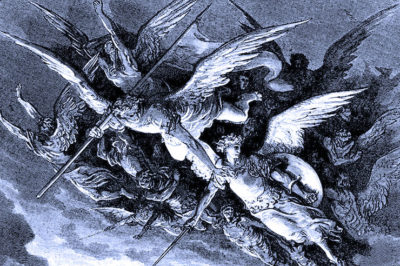
In 2002 the British newspaper The Sunday Telegraph reported that the Vatican had banned the veneration of those angels who do not appear in the authorized texts of the Bible. This was an attempt to counter the influence of unnamed New Age groups who were allegedly recruiting new members within the Roman Catholic Church. In future, prayers were only to be directed to the three archangels Michael, Gabriel and Raphael who are mentioned in the Bible. According to the apocryphal and banned Book of Enoch these were the angelic beings responsible for binding the wicked fallen angels or Watchers who had transgressed God’s law. The news report said that the early Church had excluded the book, attributed to the Old Testament prophet and patriarch Enoch, from the authorized version of the Bible because it described these fallen angels and their activities.
Who are the Watchers or fallen angels and why was the early Church and the modern Vatican so concerned about them?
Genesis 6:1-4 says: “When men began to multiply on the face of the Earth, and daughters were born to them, that the sons of God saw the daughters of men that they were fair; and took them wives of all which they chose.” Traditionally the Ben Eloha or ‘sons of God’ numbered several hundred and they descended to Earth on Mount Harmon. Significantly this was a sacred place to both the Canaanites and the Hebrews who invaded their land. In later times shrines to the gods Baal, Zeus, Helios and Pan and the goddess Astarte were built on its slopes.
These Ben Elohim or ‘fallen angels’ were also known as the Watchers, the Grigori and the Irin. In Jewish mythology the Grigori were originally a superior order of angels who dwelt in the highest heaven with God and resembled human beings in their appearance.1 The title ‘Watcher’ simply means ‘one who watches’, ‘those who watch’, ‘those who are awake’ or ‘those who do not sleep’. These titles reflect the unique relationship between the Watchers and the human race since ancient times.
In the esoteric Luciferian tradition they were a special elite order of angelic beings created by God to be earthly shepherds of the first primitive humans. It was their task to observe and watch over the emerging human species and report back on their progress. However they were confined by the divine prime directive not to interfere in human evolution. Unfortunately they decided to ignore God’s command and defy his orders and become teachers to the human race, with unfortunate repercussions for both themselves and humanity.
Most of the information we have about the Watchers and their activities comes from the apocryphal Book of Enoch. In the orthodox Bible the prophet Enoch, from the Hebrew ‘hanokh’ or instructor, is a mysterious figure. In Genesis 4:16-23 he is described as the son of Cain, the “first murderer,” and the first city built by his father is named after him. Further on in Genesis 5:18-19, and several generations later, Enoch is named as the son of Jared, and it is during his lifetime that the Watchers either arrive or incarnate in human bodies.
In the apocryphal Book of Jubilee, allegedly dictated by “an angel of the Lord” to Moses on Mount Sinai when he also received the Ten Commandments, it says that Enoch was “the first among men that are born on Earth [sic] who learn writing, knowledge and wisdom.” It says that Enoch wrote down “the signs of Heaven” (the zodiac signs) according to their months in a book. This was so human beings would know the seasons of the years in relation to the order of the months and their respective stellar and planetary influences. The indication is that Enoch received this information from extraterrestrial angelic sources, i.e. the Watchers, and therefore he was a cultural exemplar.

The Fallen Angels Instruct Humanity
Two hundred of the ‘fallen angels’ descended from the heavenly realm on to the summit of Mount Hermon and they were so smitten by the beauty of human women that, using their new material bodies, they had sex with them. This further incurred Yahweh’s wrath and, according to the Bible, the consequence of this miscegenation between the Fallen Ones and mortals led to the creation of half-angelic, half-human offspring (Genesis 6:4).
These children were called the Nefelim or Nephilim and they were the giant race that once inhabited Old Earth. The fallen angels taught their wives and children a variety of new technological skills, magical knowledge and occult wisdom. This suggests that psychic abilities and magical powers were originally an ancient inheritance from the angelic realm given to early humans. In the Luciferian tradition this is known in spiritual and metaphorical terms as the ‘witch blood’, ‘elven blood’ or ‘faery blood’ that is possessed by witches and wizards.
In the Book of Enoch it says that the leader of the fallen angels was called Azazel, and he is often identified with Lucifer (the Lightbringer) or Lumiel (‘the light of God’). He taught men to forge swords and make shields and breastplates (body armor). Azazel also taught them metallurgy and how to mine from the earth and use different metals. To the women he taught the art of making bracelets, ornaments, rings and necklaces from precious metals and stones. He also showed them how to ‘beautify their eyelids’ with kohl and the use of cosmetic tricks to attract and seduce the opposite sex. From these practices Enoch says there came much ‘godlessness’ and men and women committed fornication, were led astray and became corrupt in their ways.
This was the basis for the early Church condemning the fallen angels for teaching women to make necklaces from pieces of gold and bracelets for their arms. St Paul said that women should cover their head in the synagogue (Corinthians: 11:5-6). This was because the fallen angels were supposed to be attracted to human females with long flowing hair. The custom of women covering their hair in churches is still found in Roman Catholicism and also in the customs of Islam.
The fallen angel Shemyaza, another form of Azazel, is said by Enoch to have taught humans the use of root cuttings and the magical art of enchantment; the fallen angel Armaros taught the resolving (banishing) of enchantments; Baraqijal taught astrology; Kokabiel, the knowledge of the constellations (astronomy); Chazaqiel, the knowledge of the clouds and the sky (weather lore and divination); Shamsiel, the signs of the sun (the solar mysteries); Sariel the courses of the moon (the lunar cycles used in horticulture and agriculture and the esoteric lunar mysteries); Penemuel instructed humans in the art of writing and reading; and Kashdejan taught the diagnosis and healing of diseases and the science of medicine.
It is obvious from these descriptions of the teaching abilities of the Watchers that they were cultural exemplars and the bringers of civilization to the early human race. It is therefore strange that in orthodox Judeo-Christian religious texts they are misrepresented as evil corrupters of humanity.
Some idea of the original exalted status and real nature of the ‘sons of God’ and ‘the angels of the Lord’ can be found hidden in the ancient annals of angelic lore. For instance, Kokabiel is described as “a great angelic prince who rules over the stars.”2 In the Sibylline Oracles, Araqiel is one of the fallen angels who guides the souls of the dead to judgement in the underworld.
Shamsiel, possible originally a Babylonian sun god, was called “the prince of Paradise” because he was one of the guardian angels who watched over the gates to Eden. In this role he took Moses to see the heavenly garden and he also watched over the treasures of King David and his son Solomon the Wise. This reference may be to spiritual treasures rather than physical gold and jewels. In the Jewish Zohar he is named as the chief aide-de-camp to the mighty Archangel Uriel and bore his standard into battle.
Sariel was an angel associated with fertility of the earth and the spring equinox (northern hemisphere) in March. He governed the martial zodiac sign of Aries the Ram and was invoked for protection against the malefic power of the Evil Eye.

Azazel – Lucifer – Lumiel
Azazel, the leader of the Watchers, as mentioned before, was identified with Lucifer or Lumiel. In the Quran it is said that Lucifer-Lumiel (Iblis) rebelled against Allah because he was told to bow down and worship the clay-born “man of earth” Adam and refused. He was forced to fight a battle in Heaven with the Archangel Mikael or Michael and his Army of the Lord. As a result Lumiel and his rebel angels were cast out of Heaven and fell down to Earth. Here Lumiel became the “Lord of the World” and in Christian mythology he was falsely identified with the bogeyman Satan. However, esoterically in the Luciferian tradition, Lumiel or Lumial is not an evil satanic figure luring humankind into temptation and acts of evil as the Church represents him. He is “the angel of God [who] rebelled against the static, established cosmic order and set in motion the forces of change and evolution…”3
It is possible that Lumiel may have originated in Canaan as Shahar, the god of the morning star (Venus). He had a twin called Shalem, who was also symbolized by the planet Venus, but as the evening star. These divine bright and dark twins represented the solar light emerging from the darkness of night at dawn and descending into it at dusk. They were the children of the goddess Asherah, and there is archaeological evidence from the Middle East that the Hebrews adopted her worship when they settled in Canaan and practiced it alongside reverence of the tribal storm god Yahweh. The Old Testament has several references to the continued worship of Asherah as “Queen of Heaven” by the allegedly monotheistic Hebrews. This took place at shrines in sacred groves on hills where they made offerings of cakes and incense to the goddess. In Canaanite mythology, Shahar, as the Lord of the Morning Star, was cast down from heaven for defying the high god El in the form of a lightning bolt. In that form he fertilized Mother Earth with his divine phallic force.
Azazel is represented as a metal-smith and a fire-working sorcerer or magician. He has also been compared to the biblical first smith Tubal-Cain, a descendant of the half-human, half-angelic “first murderer” Cain. The actual name Azazel has variously been translated as ‘god of victory’, ‘the strength of God’, ‘the strong god’ and even ‘the goat god’. In the apocryphal Apocalypse of Abraham, he is called “the lord of heathens” suggesting he was originally a pagan god. He has also been identified with the serpent in the Edenic myth that seduced the first woman and “Mother of All Living,” Eve. In a Persian text known as the Urm al-Khibab or The Primordial Book, dating from the 8th century CE, the angel Azazel or Azazel is said to have refused to acknowledge the superiority of Adam over the angels. As a result Allah expelled him and his rebel angels from the heavenly realm to live on Earth. More generally in Islamic lore Azazel or Azrael is the angel of death and he acts as a guide for the souls of the dead.
In Leviticus 16:8-10 and in the Dead Sea Scrolls a curious Hebrew ritual is recorded that features Azazel as the name for the ‘scapegoat’ that takes on the communal sins of Israel. It says that the high priest Aaron took two goats from the flock and cast lots (practiced divination) to choose which one would be the scapegoat and sacrificed as a “sin offering.” The Scrolls say that the high priest confessed all the “impurities of the children of Israel” over the head of the Azazel goat. By this ritually symbolic act he transferred to the unfortunate animal all their guilt and sins so they could be absolved of them. The goat was then either cast out into the wilderness to die or thrown over a cliff to be dashed to pieces on the rocks below.
This ancient and archetypal concept of the scapegoat sacrificed for the sins of the human race and abandoned in the wilderness is a powerful and potent motif that appears several times in biblical myths. It can be seen in the story of Cain who becomes an exiled wanderer on the Earth after being marked by God and banished “east of Eden” after killing his brother Abel. In one Jewish legend the wise King Solomon, a powerful magician who could summon and control demons, fell from grace because he “whored after foreign gods.” He was forced by God to leave Jerusalem and wander in the desert disguised as a beggar.
Also after their exodus from slavery in Egypt, Moses and the Israelites were forced to spend forty years wandering in the desert before they were allowed to enter the Promised Land (Canaan). In Ancient Egyptian mythology, the dark god Set is represented as a divine outcast who dwells in the desert and, after she left Adam, his first wife Lilith or Liliya fled to the wilderness away from human habitation. In the New Testament Jesus wandered in the wilderness for forty days and nights. He was not accepted as a teacher in his own town of Nazareth and was rejected as the promised messiah by his people. When Jesus was crucified he symbolically took on the role of the sacrificial scapegoat who dies to cleanse the sins of the human race.
It is possible that the account of the ritual of the goat-god Azazel may have been an autumn equinox or harvest rite of Syrian, Hittite or Canaanite origin adopted by the Hebrews. Originally a goat would have been selected by means of a divination ritual and then offered to a desert god or demon that had to be placated by the shedding of blood. Eventually the sacrifice was made to Yahweh as a petition to forgive the sins of his followers. Azazel was popularly believed to have a retinue of hairy he-goat demons known as the se’irim who, like the Watchers, lusted after human women. It cannot be a total coincidence that the Church imagined the Devil or Satan in the form of a hairy half-human he-goat with a massive erect phallus who had sexual intercourse with his female worshippers at the Witches Sabbath.
Shemyaza is seen by some modern Luciferians as either the emissary of Lumiel or one of his avatars (an incarnated divine being in human form). He not only fell in love with human women, but also with the Babylonian deity Ishtar, the goddess of love and war. She promised to have sex with him if he would in return reveal to her the secret name of God. When Shemyaza told her, Ishtar used this forbidden knowledge to ascend to the stars and she reigned over the constellation of Pleiades or the Seven Sisters. While the other Watchers were rounded up by the archangels and punished by God, Shemyaza voluntarily repented his error and sentenced himself to hang upside down in the constellation of Orion the Hunter, with whom he is sometimes identified in the Luciferian tradition. In the Qabalistic tradition, Naamah, the sister of the biblical first smith Tubal-Cain, seduced Azazel and she has been associated with Ishtar.4
“A race between Gods and men”
As we have seen, the end result of the illicit relationships between the Watchers and “the daughters of men” was, according to Judeo-Christian propaganda, the spawning of a monstrous race of warlike, blood-drinking cannibalistic giants called the Nephilim. Genesis 6:4 less dramatically describes them as “the mighty men of old, men of renown.” At first they were fed manna (ambrosia or the food of the Gods?) by Yahweh to stop them consuming human flesh, but they rejected it. They slaughtered animals for food instead and then began to hunt down and eat human prey.
It has been speculated that this legend is based on the culinary habits of the nomadic desert herdsmen in the Middle East, who were voracious meat-eaters. In the biblical myth of Cain and Abel the dispute between the two brothers that led to the first murder is over the nature of the offerings made to Yahweh. Abel, a “keeper of sheep” or nomadic herdsman offered the “firstlings of the flock…” and Cain, who was “a tiller of the ground” or farmer-gardener offered “the fruit of the ground” (Genesis 4:2-4). Abel’s burnt offerings of animal flesh and blood were pleasing to Yahweh, but he rejected the vegetables, cereal and fruit offered by his brother. On a purely material level, as opposed to a mythic and spiritual metaphor, this story may reflect the struggle for dominance between nomadic herdsmen and the early farmers of the Neolithic Age in the Middle East.
The idea of semi-divine heroes was born from the ancient myths of unions between the Gods and mortals. The poet and writer Pindor (518-438 BCE) described the heroes of the past as “a race between Gods and men.” In the Dead Sea Scrolls the terrible human-eating Nephilim are in fact described as the guardians of arcane knowledge who “knew all the mysteries of nature and science.” There are also oblique references to the breeding techniques they taught that suggest they instructed early humans in the domestication and rearing of animals.
Additional references also hint at experiments that led to the creation of ‘monsters’ by the interbreeding of animals with different and unrelated species. In modern theosophical occultism there are legends about the lost continent of Atlantis that claim its scientists bred half-human, half-animal hybrids as a slave race. In our own time scientists are experimenting with genetic research and animal cloning experiments. It is widely rumoured that in China there have recently been abortive attempts to create a new half-human, half-animal hybrid species. These unnatural experiments led to the cataclysmic disaster that destroyed Atlantis. This also relates to the destruction of the Nephilim and the early human race in the biblical Flood. Records of such an event can also be found in the mythology of ancient peoples worldwide and especially among the Babylonians in the Middle East. In fact, it is claimed that the story of Noah and the Flood in the Old Testament originated in Babylonian and Sumerian myths.

10,000 BCE and the End of the Ice Age
It is known that around 10,000 BCE there seems to have been a cultural explosion that transformed early humankind. At the end of the last Ice Age the first signs of agriculture appeared in the Middle East with a shift from a nomadic hunter-gatherer lifestyle to that of settled farming. This marked the beginning of civilization in this area. As early as 9500 BCE barley, wheat and rye were being cultivated and oats, peas and lentils were being grown by our Neolithic ancestors in what is now modern Kurdistan, between Turkey and Iraq. At the same time dogs, goats and sheep were also domesticated. Within a thousand years copper and lead smelting was being practised in Anatolia (modern Turkey) and archaeologists believe this process was first discovered in Kurdistan, along with weaving and pottery making. The ancient Kurdish culture was also the first to develop a script and was one of the earliest literate societies in the Middle East.
The Kurds claim to be the descendants of the ‘Children of the Djinn’ (spirits), the offspring of a mating between the djinns and mortal women. In some parts of Kurdistan, especially among the sect of Yezedis, who worship the Peacock Angel (Azazel, the leader of the fallen angels), can be found tall, fair-haired people with blue eyes. Although anthropologists believe they may be of ancient European ancestry, popular folk belief among the Kurds says they are descendants of the ‘Children of the Djinn’, who in ancient times brought civilization to early humankind.
In general the ancient Middle East was known as ‘the cradle of civilization’ with the earliest city-states being founded in the Mesopotamian area (modern Iraq and Iran). The early indigenous people of the region, the Sumerians and Akkadians, developed the first written language, studied astronomy and created libraries. The Babylonians and Assyrians followed them and in the mythology of all these races are stories of how the Gods descended to Earth and taught them the arts of civilization.
In the Book of Enoch it says that when Yahweh saw the lawlessness, chaos, corruption and sexual immorality that had been caused by the interaction of the Watchers and humans he decided to intervene through the agency of the archangels Michael, Raphael, Gabriel and Uriel. He commanded Raphael to bind Azazel hand and foot like a sacrificial goat and cast him into a deep ravine in the desert. Gabriel was sent on a divine mission to destroy “the bastards and reprobates” and “the children of the Watchers amongst men.”5 The Archangel Michael, the commander of the Army of God, was sent to arrest Shemyaza and bind him “under the earth” until Judgement Day. As we have seen, the fallen angel repented his sins and sentenced himself to cosmic exile among the stars.
The Book of Jubilee says that the archangels bound the Watchers “in the depths of the earth” and in Judaic lore they are imprisoned in a mysterious “second Heaven.” However, it is also said that some of these “mighty warriors” have a special place reserved for them in Sheol, the Jewish underworld. There they are said to lie in state “with shield and spear intact.”
Christian O’Brien has suggested6 there is a connection between the biblical Watchers and the semi-divine, semi-mythical Tuatha De Danann (Children of the goddess Dana). This race of ancient magicians descended to Earth on the sacred hill of Tara in prehistoric Ireland. With the coming of Christianity, the Tuatha De Danann was banished into the ‘hollow hills’ and became the Sidhe (Shee) or ‘Shining Ones’, the elves and faeries of Irish folklore. There has always been a strong belief among the peasantry in Ireland that the Good People or faeries were originally the fallen angels who sided with Lucifer in the Battle of Heaven.
In this article we have constantly referred to the Watchers as angelic beings with a spiritual form who incarnated in physical bodies to have sexual relations with mortal women. In recent years a considerable amount of speculative literature has been published suggesting that instead they were of earthly origin. Popular best-selling authors such as Andrew Collins,7 Graham Hancock and Ian Lawson have claimed that the biblical myth of the Watchers represents memories of a primeval ‘elder race’ of super-humans belonging to a lost civilization who taught their technology to more primitive people. Lawson has claimed that this (unknown) ancient race may have been spiritually advanced souls who incarnated to help early humankind and were corrupted by them in the process. Collins has also recently launched a new project to investigate the magical aspects of the legend.

Symbolism of the Myth of the Fallen Angels
What is the esoteric significance behind the myth of the fallen angels, the expulsion of Lucifer from Heaven and the Fall of Man as represented by the Garden of Eden saga? In the Bible Lucifer is often depicted in the reptilian form of a dragon or serpent and in the West this creature is symbolic of evil and the powers of chaos. Babylonian, Hittite, Canaanite, Iranian, Egyptian, Greek and Norse myths all describe in various forms a struggle between a supreme father-god, representing cosmic order and harmony, and a younger rebellious god who challenges and tries to overthrow divine authority. Although these conflicts usually take place in a pre-human epoch, they are also sometimes depicted as occurring in world history and are often connected with the creation and early development of the human species and the rise of ancient civilizations.
Symbolically, Lucifer or Lumiel is known as the Lord of Light as he is the first-born of creation. He represents the active cosmic energy of the universe and has been identified with fire, light, phallic power, independent thought, consciousness, progress, liberty and independence. The founder of the modern Theosophical Society, Madame Helena Blavatsky, described the Lightbringer as “the spirit of intellectual enlightenment and the freedom of thought” without whose influence humanity would be “no better than animals.”8
In the Bible Lucifer (or Satan as he is mistakenly called) is often depicted in reptilian form as either a dragon or a serpent. In Western mythologies this creature is commonly misrepresented as a symbol of the powers of darkness, chaos and evil. In contrast, in Eastern mythology the dragon is a good omen representing fertility and good fortune. Lumiel-Lucifer is often identified with the serpent in the Edenic myth described in Genesis. In the Luciferian tradition, the biblical serpent is regarded as the personification of knowledge, wisdom and enlightenment who liberated the first humans from the spiritual ignorance imposed on them by Yahweh. The serpent is seen as the symbol of an outside liberating force that quite literally opened the eyes of Adam and Eve to the reality of the created universe and the wonders of the material world.
The snake, serpent or dragon is an ancient mythical and archetypal image of the solar phallic power or life force that is associated with Lucifer and the explosion of light following the divine celestial event that created the universe (known by modern scientists as the Big Bang). When the first man and woman ate the forbidden fruit from the Tree of the Knowledge of Good and Evil in the astral or heavenly garden, they became consciously aware. Their first realization was that their physical ‘cloaks of flesh’ were naked. They rushed to cover their genitals as they had become aware of the so-called ‘serpent power’ or kundalini that can be raised by sexual intercourse and non-reproductive sex acts. They also ate from the Tree of Life which initiated the cycle of birth, life, death and rebirth and of human souls incarnating in physical form.
Interestingly, the anthropologist and shamanic teacher Dr. Michael Harner has described an experience he had in the jungle of the Peruvian Amazon after partaking of the hallucinogenic vine ayahuasca. He had a vision of a dragon-prowed ship with a crew of bird-headed humans. He then encountered an ancient race of reptilian entities that he believes exist within each human being in the brain stem at the base of the skull and the top of the spinal column. These reptilian life forms told Dr. Harner they had arrived on Earth aeons ago from the stars. Allegedly, they created life here so they had somewhere to hide and were the true masters of the planet. The anthropologist mentioned this to an old Indian shaman and he said he knew about these entities and called them the “Masters of the Outer Darkness.”9
The myth of the Watchers, the Fall of Lucifer and the Fall of Man all represent the primeval Dreamtime or ‘Golden Age’ of cosmic and earthy harmony and primal innocence that may have existed on the material plane or on some kind of astral or pre-material plane. It is the symbolic or actual physical destruction of this heavenly or earthly paradise, where humans and animals lived together and communicated by a universal language, which is reflected in such myths and legends. In shamanic terms it is known as the Great Separation when humans no longer knew or understood the language of the animals. It was also a time when humans began to communicate together in different languages and this is represented by the biblical story of the Tower of Babel.
The myth of the Golden Age or Paradise on Earth is closely linked with the fall of Lucifer from Heaven and the diminishing of his former status as the first-born of creation to become the Lord of the World. On a symbolic and metaphorical level, as well as a physical one, it is also connected to the separation of humans from nature and their natural environment that is manifesting in our modern times. It was the deliberate intervention of Lucifer and the fallen angels in human evolution, rather than any defiance of cosmic authority, which ultimately lead to their fall from heavenly grace. The Watchers’ only ‘crime’ was that they wanted to help the progress of their human flock. However, the refusal of Lucifer-Iblis to recognize the creation of human beings means that the Fall from heavenly grace was inevitable.
In the Luciferian tradition Lumiel is promised redemption and the restoration of his former status in the cosmic plan. This can only come to pass when the human race spiritually evolves. So it is to the benefit of Lumiel and his teaching angels to help us achieve that end. The relationship between humanity and the leader of the Fallen Ones is therefore very much a symbiotic one, as they need each other.



Comments
Post a Comment